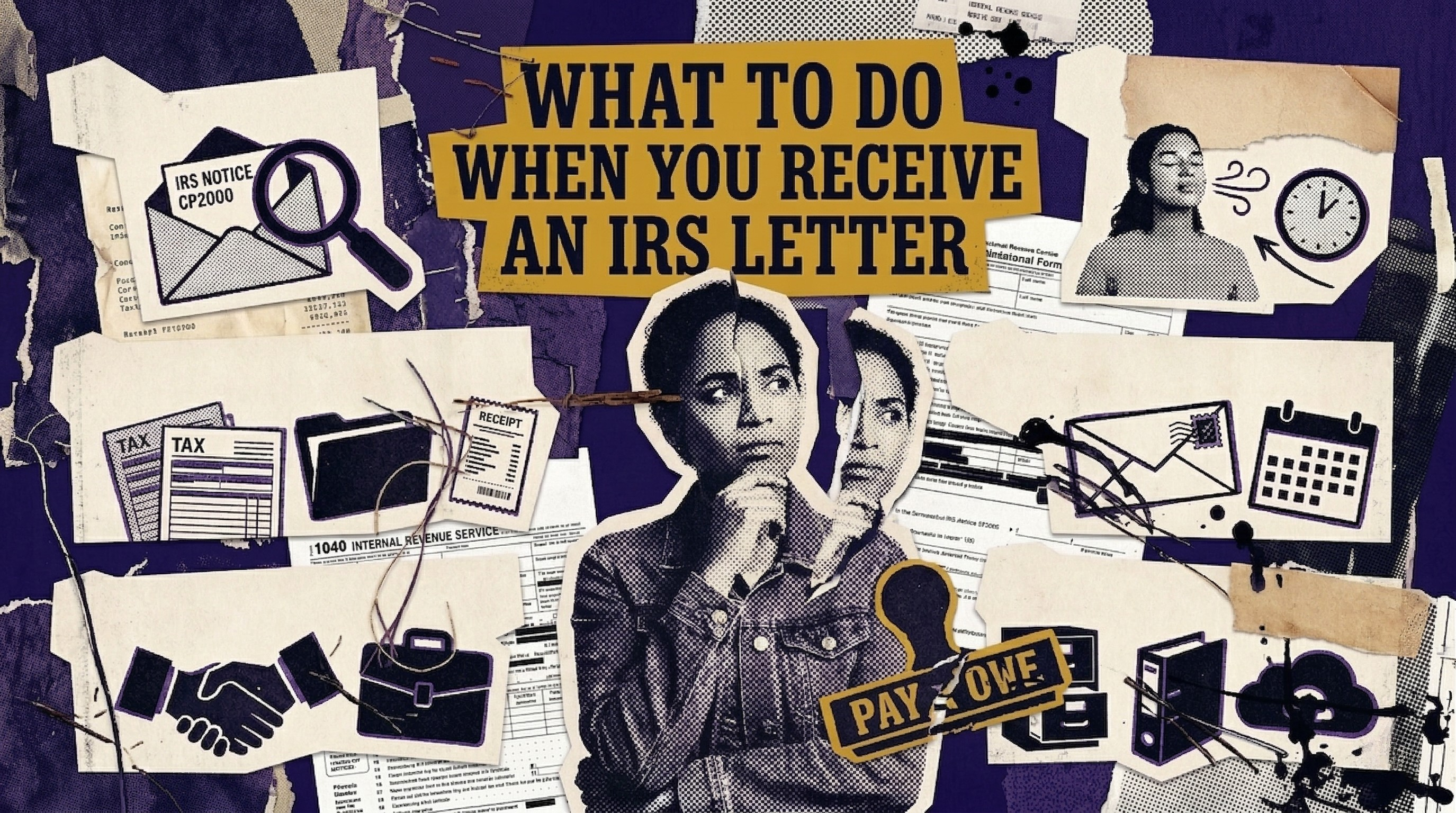
Opening your mailbox to find an envelope from the IRS is enough to make anyone's stomach drop. But before you panic, take a breath. Receiving an IRS notice doesn't automatically mean you're in serious trouble. In fact, many IRS notices are routine — but every single one requires your attention. Here's exactly what to do when you get an IRS notice, step by step.
Step 1: Don't Panic — But Don't Ignore It Either
The worst thing you can do with an IRS notice is set it aside and hope it goes away. It won't. The IRS operates on strict timelines, and failing to respond by the deadline can result in additional penalties, interest, or even collection action. That said, most IRS notices are not cause for alarm on their own.
The IRS sends millions of notices every year for routine reasons: requesting documentation, notifying you of a change to your return, or simply confirming that a payment was received. A notice is not the same as an audit, and it does not mean you're being investigated. Stay calm and move forward methodically.
Step 2: Read the Notice Carefully
Every IRS notice includes a notice number printed in the upper right corner of the letter. This notice number tells you exactly what the IRS wants and why they're contacting you. The letter will also include a deadline for your response and instructions for what to do next.
Read every word of the notice before doing anything else. Many notices are informational and require no action at all — for example, a CP14 notice simply lets you know that you have a balance due, while a CP501 is a reminder that a balance remains unpaid. Understanding what you're dealing with is the first step to handling it correctly.
Write down the notice number, the tax year it references, and the response deadline. Keep the original letter in a safe place — you'll need it if you speak with the IRS or a tax professional.
Step 3: Know the Common IRS Notice Types
Familiarizing yourself with the most common IRS notice types can help you understand the urgency and appropriate response for your situation:
CP2000 — Underreported Income: This is one of the most common notices families receive. It means the IRS found income reported by a third party (like an employer or bank) that doesn't match what you reported on your return. It is not an audit — it's a proposal. You have the right to agree, disagree, or provide additional documentation.
CP501 — Balance Due Reminder: This is a first reminder that you have an unpaid balance. It outlines what you owe including penalties and interest. If you can pay in full, doing so quickly stops further penalty accumulation. If you can't, you have options.
CP503 — Second Balance Due Notice: This is a follow-up to the CP501. At this stage the IRS is escalating its request for payment. If you haven't already, now is the time to set up a payment plan or contact a tax professional for help with resolution options.
CP504 — Intent to Levy: This is a serious notice. It means the IRS intends to seize state tax refunds or other assets to satisfy your debt. If you receive a CP504, you should contact a tax professional immediately. You still have rights and options, but time is short.
LT11 or Letter 1058 — Final Notice of Intent to Levy: This is the final warning before the IRS can begin levying wages, bank accounts, or other assets. This requires urgent action. If you receive one of these, do not wait.
Step 4: Verify It's Legitimate
IRS impersonation scams are widespread. Before responding to any notice, verify that it is genuine. Legitimate IRS notices arrive by mail — the IRS does not initiate contact by email, text message, or social media. Real IRS letters include the notice number, a return address from the IRS, and instructions to respond by mail or call the number printed on the notice itself (not a random number provided in the letter).
If you're unsure whether a notice is real, you can verify it by calling the official IRS number at 1-800-829-1040, or by checking the IRS website directly. Never call a number listed on a suspicious letter without verifying it first.
Step 5: Respond by the Deadline
Every IRS notice includes a response deadline, typically 30 to 60 days from the date of the notice. Missing this deadline can result in additional penalties, the waiver of your appeal rights, or accelerated collection action. Mark the deadline on your calendar the moment you open the letter.
If you agree with the notice, follow the instructions to pay or resolve the issue by the deadline. If you disagree, gather your documentation — pay stubs, receipts, bank statements, tax forms — and prepare a written response explaining your position. Send your response via certified mail so you have proof of the date it was sent.
Step 6: Understand Your Options if You Owe
If the notice says you owe money and you agree with the amount, you don't have to pay it all at once. The IRS offers several resolution options for taxpayers who can't pay in full:
Installment Agreements let you pay your balance over time in monthly installments. Short-term plans are available for balances under $100,000, and long-term plans are available for larger balances with extended repayment periods.
Offer in Compromise (OIC) allows qualifying taxpayers to settle their tax debt for less than the full amount owed. The IRS evaluates your income, expenses, assets, and ability to pay. Not everyone qualifies, but for those who do, the savings can be substantial.
Penalty Abatement may be available if you have a history of compliance and this is your first offense. First-time penalty abatement can eliminate significant penalty charges without requiring proof of reasonable cause.
Currently Not Collectible (CNC) status is available if you genuinely cannot afford to pay anything without failing to meet basic living expenses. The IRS temporarily halts collection while you're in CNC status.
Step 7: Know When to Get Professional Help
Many straightforward notices can be handled on your own — but others are complex, high-stakes situations that require professional representation. You should strongly consider working with a tax professional if:
The notice references a large amount you believe is incorrect. You've received a CP504 or LT11 levy notice. The notice involves a proposed audit or examination. You disagree with the IRS's position and need to file a formal appeal. You owe more than you can pay and need help negotiating a resolution.
A qualified tax resolution professional can review the notice, communicate with the IRS on your behalf, and protect your rights throughout the process. At Fiscus Max, we handle IRS correspondence and resolution for families every day — and we never leave you to face the IRS alone.
The Bottom Line on IRS Notices
An IRS notice is not the end of the world. It is a communication that requires a response. The key is to stay calm, read carefully, act within the deadline, and get professional help if the situation calls for it. Ignoring an IRS notice is never the right choice — but neither is panicking. Knowledge and prompt action are your best tools.
← Back to Tax Resources