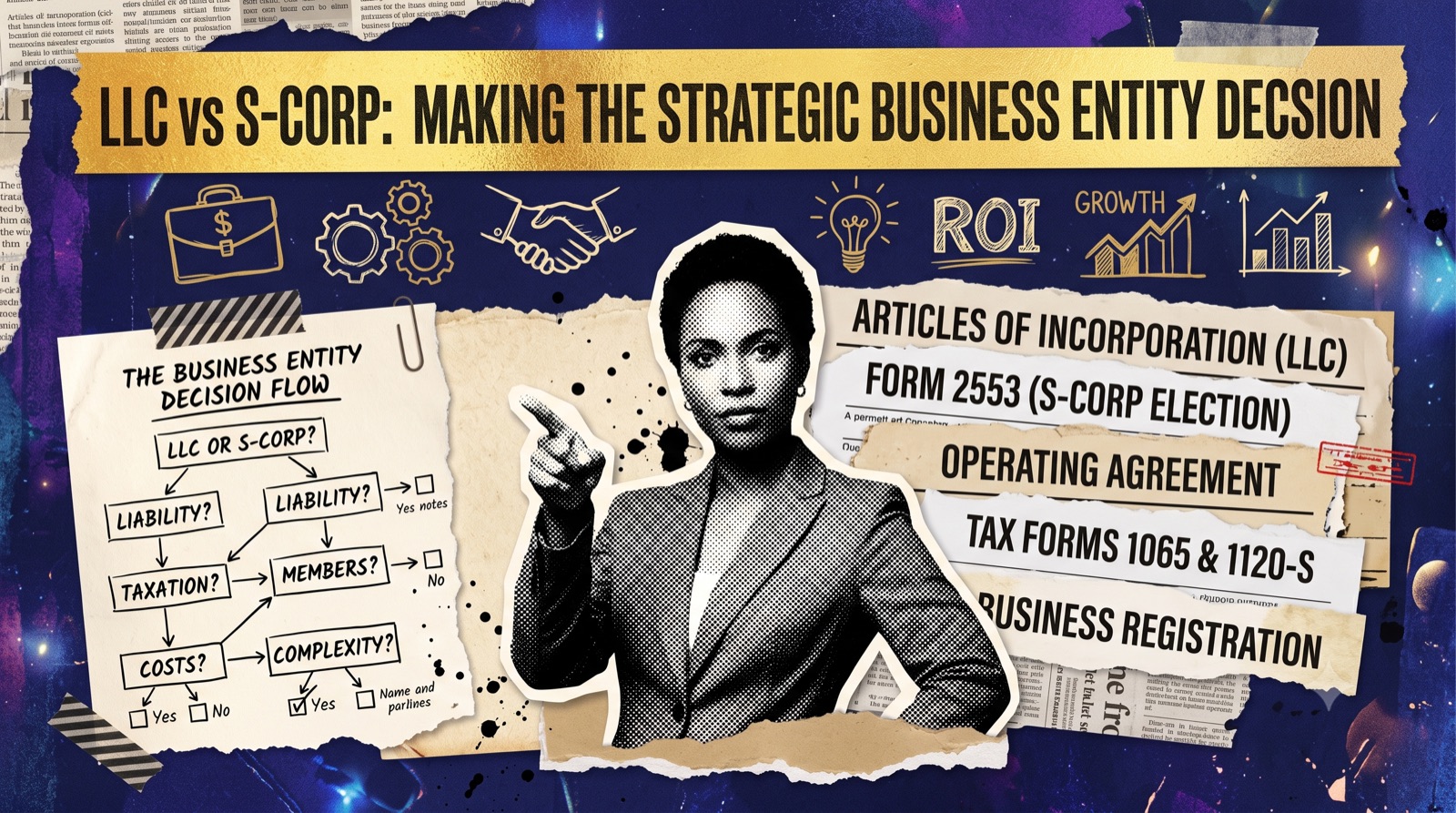
One of the most consequential tax decisions a business owner ever makes happens before the business even opens its doors: how to structure it. Sole proprietorship, partnership, LLC, S-corp, C-corp — each comes with a different tax treatment, different paperwork, and a different ceiling on how much you can ultimately save. Get it wrong, and you could be overpaying every single year without ever realizing there was a better option.
The Default Isn’t Always the Best Option
Most businesses start as a sole proprietorship or single-member LLC almost by accident — it’s simply what happens when someone starts earning money without filing anything else. It’s the simplest option, but it also means all business profit is subject to self-employment tax on top of ordinary income tax, with no way to separate a reasonable salary from additional profit. For a side hustle or a business still finding its footing, that simplicity has real value. But once profit grows past a certain point, that same simplicity starts costing real money every year, and it’s worth revisiting the choice rather than assuming the entity you started with is the one you should keep.
Where S-Corps Change the Math
Electing S-corp treatment allows an owner to split business income into a reasonable salary, which is subject to payroll taxes, and additional distributions, which generally aren’t. For profitable businesses, that split can meaningfully reduce the total tax bill compared to a sole proprietorship or default LLC treatment. The tradeoff is complexity: S-corps require payroll, a defensible “reasonable salary” determination, and more disciplined bookkeeping. This structure tends to make the most sense once profit reaches a level where the payroll tax savings clearly outweigh the added administrative cost — below that point, the extra complexity may not be worth it yet.
When C-Corp or Partnership Structures Make Sense
C-corps are less common for small, owner-operated businesses because of the potential for double taxation — once at the corporate level, again when profits are distributed — but they can make sense for businesses planning to reinvest heavily, raise outside investment, or eventually go public. Partnerships and multi-member LLCs offer flexibility in how profit and loss are allocated among owners, which can matter a great deal when partners contribute unevenly in capital, labor, or risk. There’s no universally “best” structure — only the one that fits your specific profit level, growth plans, and ownership situation.
Revisit the Decision, Don’t Just Set It
Entity choice isn’t a one-time decision made at formation and forgotten. As revenue grows, as ownership changes, or as plans shift toward a sale or outside investment, the optimal structure can shift too. Many business owners are still operating under whatever entity they picked in their first year, years after that choice stopped being the right one.
Is your business structured to minimize what you owe, or just to get by on whatever you picked when you started? The right entity can save real money every single year — and the wrong one quietly costs you the same amount, year after year, without ever sending a warning.
General education only — not individualized tax, legal, or financial advice.
← Back to Tax Resources