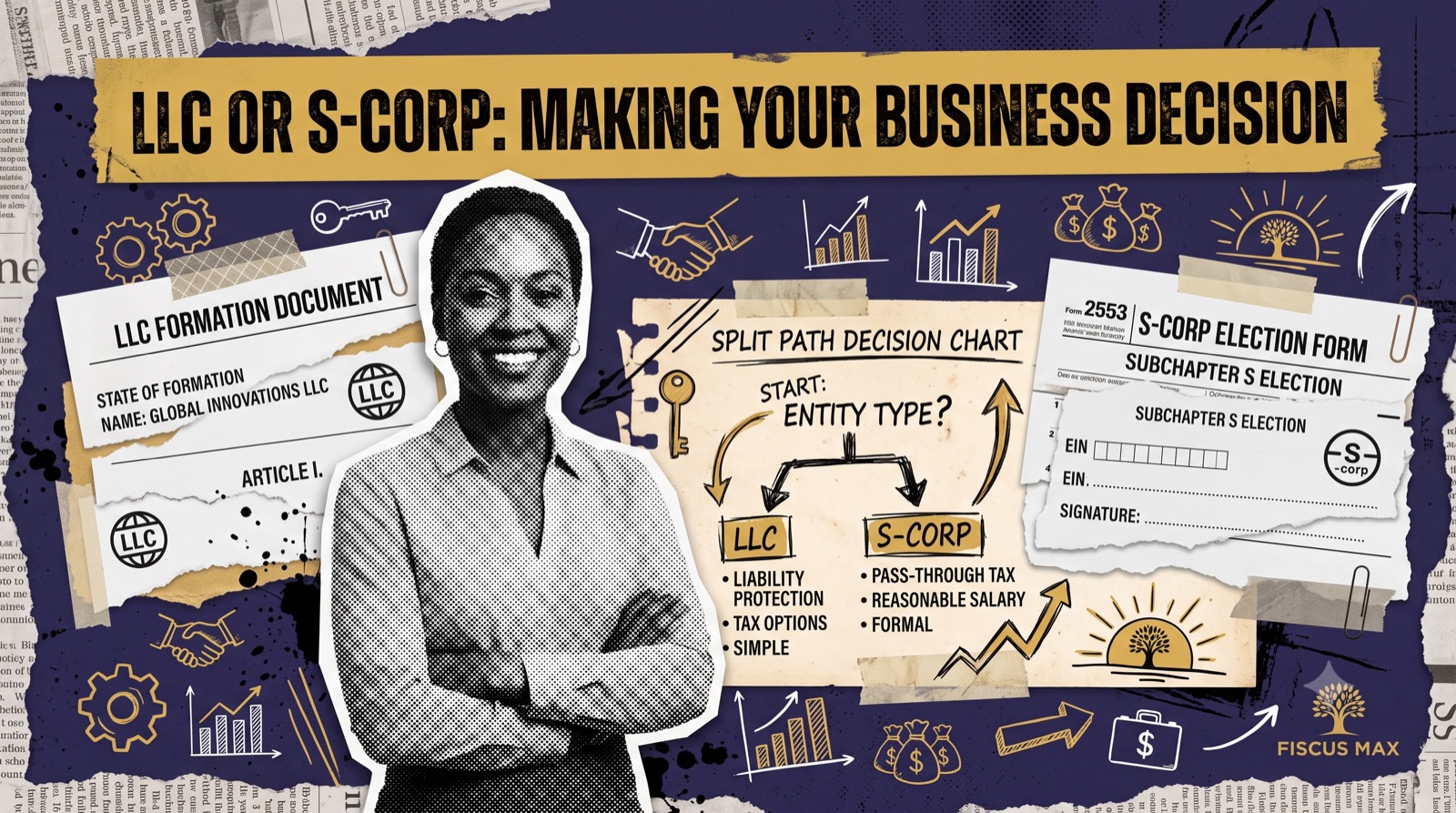
“LLC” and “S-corp” get used almost interchangeably in casual conversation, but they’re solving different problems. An LLC is a legal structure — it dictates liability protection and how the business is organized. S-corp is a tax election — it dictates how profit gets taxed. You can actually have an LLC that elects to be taxed as an S-corp, which is exactly where a lot of the real savings live, and exactly where a lot of business owners get confused about what they actually have.
What an LLC Actually Controls
Forming an LLC creates legal separation between you and the business — your personal assets are generally protected from business liabilities, and the paperwork requirements are lighter than a full corporation. By default, a single-member LLC is taxed as a sole proprietorship and a multi-member LLC is taxed as a partnership, meaning profit flows straight through to the owners’ personal returns and is subject to self-employment tax on top of income tax. That default taxation is where LLCs, on their own, start to cost more than they need to once the business becomes genuinely profitable. The legal structure and the tax treatment are two separate decisions, and an LLC lets you choose the legal shell while still deciding separately how you want the IRS to see it.
What Changes When You Elect S-Corp Status
An LLC (or a corporation) can elect to be taxed as an S-corp without changing its underlying legal structure. Once that election is in place, the owner becomes an employee of the business, paid a reasonable salary subject to payroll taxes, while remaining profit can be distributed without the added self-employment tax burden. For a profitable business, that split between salary and distribution is where the real savings show up — it’s not a loophole, it’s simply a different, IRS-sanctioned way of receiving the same profit. The tradeoff is real complexity: payroll needs to be run correctly, salary has to be defensible as “reasonable” for the work performed, and bookkeeping needs to support the split cleanly if it’s ever questioned.
When the Complexity Is Worth It
S-corp election tends to pay for itself once profit clears a threshold where the payroll tax savings meaningfully exceed the added cost of running payroll and more sophisticated books. Below that threshold, the extra moving parts can cost more in accounting fees and administrative time than they save in tax. This is a math problem specific to your business, not a rule of thumb that applies the same way to every owner — a business with modest profit and a business with substantial profit are not making the same decision, even if they’re structured identically today.
Getting the “Reasonable Salary” Right
The most common mistake with S-corp elections is setting the salary too low to maximize distributions, which is exactly the pattern that draws scrutiny. Reasonable salary should reflect what you’d have to pay someone else to do your job, based on industry, role, and experience — not the smallest number you can justify. Getting this number wrong doesn’t just risk an audit; it can unwind the tax benefit that made the election worthwhile in the first place.
Are you missing deductions built specifically for owners like you? The right structure and the right salary split can be worth thousands every year — and most owners never revisit the decision after year one.
General education only — not individualized tax, legal, or financial advice.
← Back to Tax Resources